On a dryer that turns but will not heat, check the vent before anything else. A blocked vent makes the dryer overheat, which blows the thermal fuse ($120 to $260) or burns out the heating element ($180 to $400), and replacing either one without clearing the vent just breaks the new part.
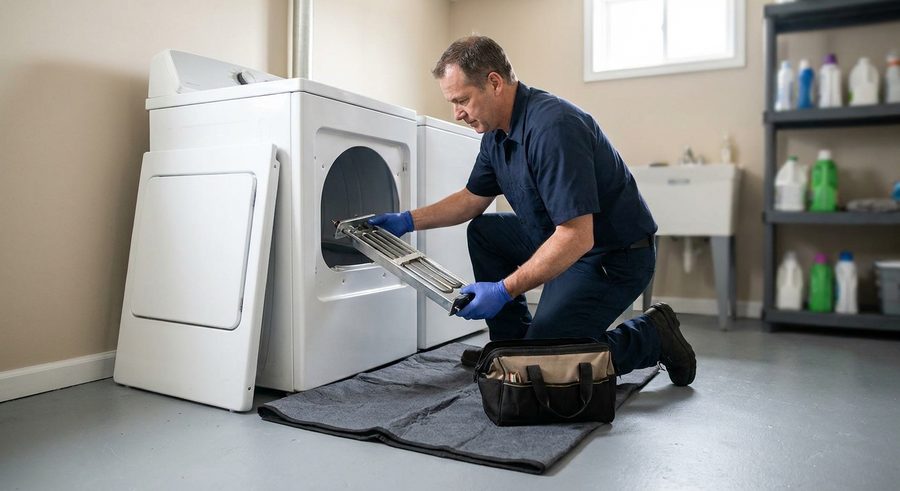
What to check, in order
Free checks first. The cheap causes are also the common ones.
Check the whole vent, not the lint trap
Pull the dryer out and take the duct off the back, then check the full run to the hood outside. The lint that causes this collects in the duct and at the hood, where you cannot see it from inside the laundry room.
Look at the hood outside
In winter the flap ices over or gets banked in with snow. That gives you exactly the same symptom as a dead heating element and costs nothing to fix.
Check both breakers on an electric dryer
An electric dryer runs on two legs of power. If one leg trips, the drum still turns and the heat does not. Switch the breaker fully off and back on before you assume a part has failed.
Work out whether it is gas or electric
Electric points at the heating element, the thermal fuse or the cycling thermostat. Gas points at the igniter or the gas valve coils, which run $180 to $420. Same symptom, different part, different job.
Where to stop
Past the vent and the breaker, the element, the fuse and the igniter all sit behind a panel with live terminals, and a gas dryer has a gas connection back there as well. Gas work is never a DIY job. That is the point to call. Waiting is not neutral here either: every cycle on a blocked vent packs more lint into the duct, and lint in a hot duct is how dryer fires start.
- Behind a panel there are live terminals, sharp edges and sometimes a sealed refrigerant circuit.
- Replacing a part you guessed at is the expensive way to diagnose. A meter settles in a minute what a parts order settles in a week.
- If the machine is inside a manufacturer warranty, opening it yourself can end that cover.
- A burning smell or a scorched connector means stop, unplug it and leave it.
What the repair runs if it is not a free fix
| Part | Typical range |
|---|---|
| Heating elementRuns but will not heat, on an electric dryer | $180 to $400 |
| Thermal fuse or cycling thermostatCheck before the element. A blown fuse is frequently a symptom of a blocked vent rather than a fault | $120 to $260 |
| Igniter or gas valve coilThe gas dryer equivalent of a failed element | $180 to $420 |
| Drum rollers, idler pulley or beltSquealing, rumbling or thumping | $180 to $400 |
| Rear drum bearingA deeper noise than the rollers, and a longer job | $250 to $500 |
| Moisture sensorShutting off early on an auto dry cycle | $140 to $300 |
| Door switch or start switchWill not start at all | $120 to $260 |
| Blower wheelPoor airflow where the vent is already clear | $180 to $380 |
For comparison, a replacement typically runs $650 to $1,500 installed, which is the figure to compare against rather than the shelf price.
Questions people ask
What brands are worth repairing?
Whirlpool, GE, Maytag, Frigidaire and LG cover most kitchens around here, and parts for all of them are current. A model dropped ten years ago often still has common parts available even when its control board does not. Ask what the part is and whether anybody still makes it.
Can I still get parts for an old appliance?
An appliance built before control boards is often very repairable. The sticking point is a circuit board from a model that sold in small numbers, because nobody reproduces those. Ask whether that exact part is still available for your model.
What should I do to get ready?
The model number, what the machine is doing, and when it started. Those are the three. Pull the unit out if it moves easily. If it does not, say so, because a built in is a different job. Have the model number ready and tell us what the machine is doing.
Related questions
Washer leaking from the bottomWater under a washer is worth fixing this week, because the damage goes into the floor and the cabinets rather than into the machine.Oven not heating upAn oven that will not heat is almost always one part: the bake element on an electric oven, the igniter on a gas one.Washer will not drain or spinThese two symptoms travel together, because a washer that cannot drain will refuse to spin.Past the free checks?
Call with the model number and the list of what you already tried.
(716) 414-5233