Most refrigerator repairs cost $120 to $700. The part that failed sets the price, so a start relay and a control board are nowhere near the same bill, and opening the sealed system is a bigger job again at $700 to $1,800.
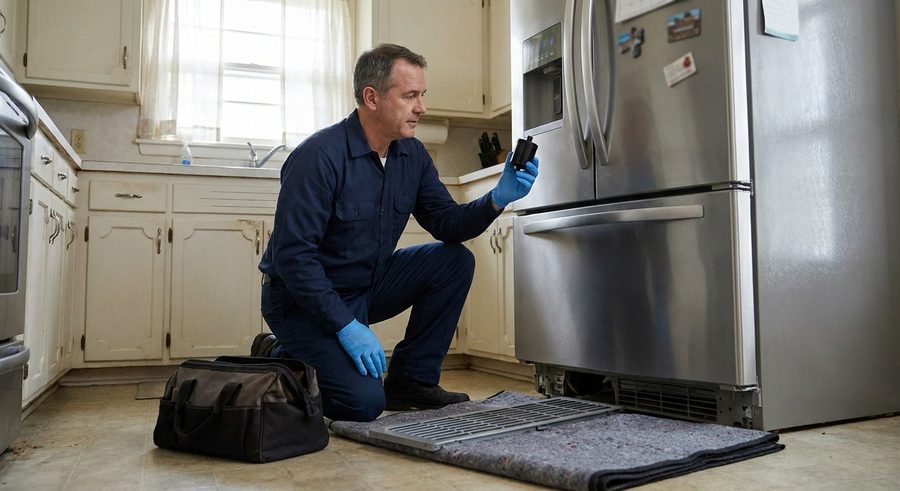
The two cheap failures to rule out first
A refrigerator that stops cooling is most often a start relay or a fan motor. The relay is the small box clipped to the side of the compressor, and its job is getting the compressor spinning. It runs $120 to $250 with labor. A condenser or evaporator fan motor runs $150 to $350.
You can usually tell them apart by ear. A click every few minutes followed by silence points at the relay. A warm fresh food section with a freezer that is still cold points at the evaporator fan or the damper between the two sections, not at the compressor.
Say what you heard when you call. A tech can test either part on the spot with a meter, and knowing which one to test first keeps the visit short.
What moves the price up
Labor costs about the same whether the part is $40 or $400, so the part does most of the work on the final number. Three things push it up. An electronic control board instead of a mechanical control runs $350 to $700. A built-in cabinet has to come out before anyone can reach the back of the machine. And any work that opens the refrigerant circuit is a different class of job.
That last one is the real cliff. Compressor and sealed system work runs $700 to $1,800. It takes a licensed tech with recovery equipment, a shop prices it on its own rather than off a list, and it is the one failure that regularly makes a new refrigerator the better buy.
When a replacement is the better answer
A new refrigerator typically runs $900 to $2,600 installed. Compare the repair against that number, not against the price on the showroom tag. Delivery, hauling the old one out and any work the opening needs are all real money, and in an older kitchen the opening is often the biggest of the three.
If the sealed system is sound, a refrigerator is usually worth fixing well past the age most people assume. The decision flips when the expensive half is the half that failed, or when the part is discontinued. A control board nobody makes any more ends the argument. The rest of the machine can be perfect and it will not matter.
Leaving it alone has a price too. A compressor working against a coil packed with dust runs hot and runs all day. That is how a $150 to $350 fan job turns into the $700 to $1,800 repair nobody wanted.
Typical ranges by part
| Part | Typical range |
|---|---|
| Start relay or overload protectorOne of the two cheap failures worth ruling out first on a unit that is not cooling | $120 to $250 |
| Condenser or evaporator fan motorThe other one. A clicking every few minutes points here or at the relay | $150 to $350 |
| Defrost heater or thermostatHeavy frost on the back wall, or a unit that cools then warms | $180 to $400 |
| Thermistor or temperature sensorRunning constantly without reaching temperature | $130 to $280 |
| Door gasketVaries most by model; a built in gasket costs far more than a freestanding one | $150 to $400 |
| Electronic control boardThe modern cost driver. A mechanical predecessor was a fraction of this | $350 to $700 |
| Compressor or sealed systemThe one real cliff. Opening the refrigerant circuit is a different class of job and is quoted on its own | $700 to $1,800 |
For comparison, a replacement typically runs $900 to $2,600 installed, which is the figure to compare against rather than the shelf price.
What this looks like in an older house
Most of the houses around here are old. In Bradford about three in five went up before 1940, and Warren, Olean and Jamestown are all above half. In a house that age the cabinet opening, the doorway and the circuit were all sized for a smaller machine than anything sold today.
So a new one often needs work doing before it even fits, and none of that shows on the price tag. A repair skips it. What the fit problem costs in an older house.
Questions people ask
Is it worth repairing, or should I replace it?
Fix it if the repair costs well under a new one and the body of the machine is still sound. If the sealed system is intact, a fridge is usually worth fixing for longer than people think. Ten to eighteen years is a normal life for one. The diagnosis answers this. Call and get one.
Can I still get parts for an old appliance?
Older machines were built to be opened up, and that counts for a lot. Gaskets and door seals for old models are the quiet problem. They perish on a schedule and they only fit one model. The sticker on the machine answers this. Have the numbers ready.
What does appliance repair usually run?
Price follows the part, and the parts that fail most often are the cheap ones. Sealed system work is the one real cliff. Opening the refrigerant circuit is a different class of job from swapping a switch. Call us with the model number and the symptom, and ask which part is likely.
Related questions
Dryer squeakingA squealing or thumping dryer is usually worn drum rollers, a worn idler pulley or a rear drum bearing.Washer leaking from the bottomWater under a washer is worth fixing this week, because the damage goes into the floor and the cabinets rather than into the machine.Oven not heating upAn oven that will not heat is almost always one part: the bake element on an electric oven, the igniter on a gas one.Get the fault named first
The part decides the price, so the diagnosis comes before the figure.
(716) 414-5233