Most washer repairs are worth doing, because the parts that usually fail run $140 to $400. Two faults change that answer: a drum bearing and a cracked outer tub, both at $600 to $1,200 against a new machine at $700 to $1,600 installed.
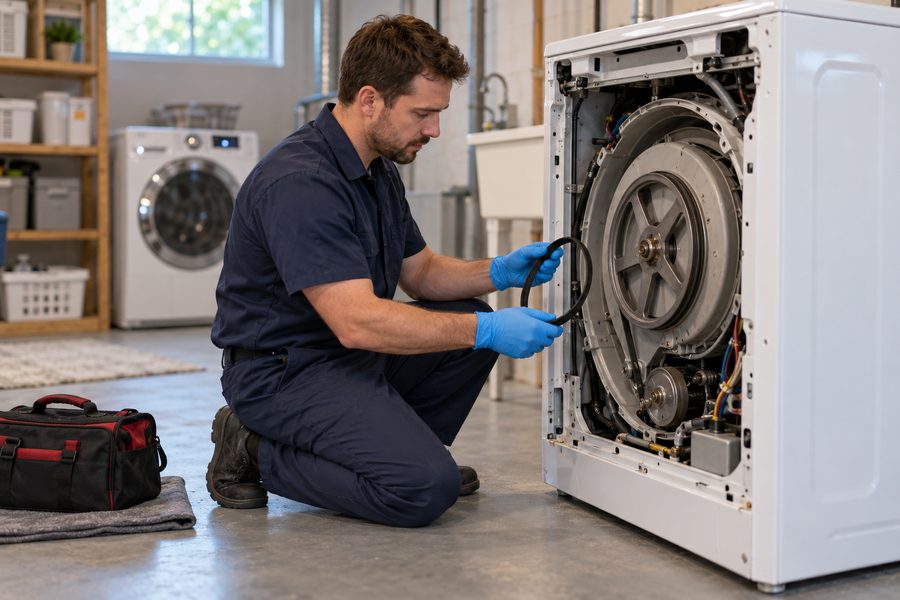
The faults that make a repair easy
A drain pump at $180 to $400, a lid or door lock switch at $140 to $300, a water inlet valve at $150 to $320, a belt or motor coupler at $150 to $350 and a pressure sensor at $160 to $350 are all everyday parts. On a machine that has been reliable, any one of them is an easy yes.
They also cover most of what goes wrong. Will not drain is nearly always the pump or a blocked filter. Will not spin is usually the lid switch or the coupler. Walking across the floor on spin is usually leveling or suspension before it is anything expensive.
The two that usually end it
A failed drum bearing or a cracked outer tub runs $600 to $1,200. Against a machine that costs $700 to $1,600 to put in, that is where most people stop. The part is expensive and the job is deep, because the machine has to come apart down to the tub to reach it.
A discontinued control board ends it the same way. If nobody makes the part, the age and condition of the machine stop mattering.
Front loader or top loader changes the answer
A direct drive top loader is simple and stays fixable for a long time. A front loader carries more control hardware and a door seal that perishes on a schedule, so it tends to need more visits over its life.
Count what you have already replaced before you decide. A new machine is not automatically more reliable. It carries electronics the old one never had.
One thing not to ignore. A washer that walks across the floor is pounding its own bearing every spin, so a suspension job at $200 to $450 is the usual way people end up at the $600 to $1,200 bearing job.
Typical ranges by part
| Part | Typical range |
|---|---|
| Drain pumpNearly always the cause of a machine that will not drain | $180 to $400 |
| Lid or door lock switchThe usual reason a washer will not spin or will not start | $140 to $300 |
| Drive belt or motor couplerWill not spin, or spins without agitating | $150 to $350 |
| Water inlet valveWill not fill, or fills slowly | $150 to $320 |
| Water level or pressure sensorStopping mid cycle, or overfilling | $160 to $350 |
| Suspension rods or dampersWalking across the floor on spin, where levelling has not fixed it | $200 to $450 |
| Main control boardDiagnosed last, because a cheaper sensor usually explains the same symptom | $300 to $650 |
| Drum bearing or outer tubFrequently the point at which a replacement becomes the better value | $600 to $1,200 |
For comparison, a replacement typically runs $700 to $1,600 installed, which is the figure to compare against rather than the shelf price.
Questions people ask
What does appliance repair usually run?
The honest answer is a range. The same symptom can have a cheap cause or an expensive one. The labor is much the same whether the part is cheap or expensive, so the part price is what separates a small bill from a big one. Ask for the full price, parts and labor together, not just the part.
Can an older appliance still be worth fixing?
If one part failed on a machine that has been fine until now, fix it. Saving on energy is real but slow. It rarely catches up with a repair that costs a fraction of a new unit. Get the fault named first. The choice is easy once you know the part.
Can I still get parts for an old appliance?
An appliance built before control boards is often very repairable. A mechanical timer, a belt, a drive motor and a water valve are common parts and still widely stocked. The sticker on the machine answers this. Have the numbers ready.
Related questions
Dryer squeakingA squealing or thumping dryer is usually worn drum rollers, a worn idler pulley or a rear drum bearing.Washer leaking from the bottomWater under a washer is worth fixing this week, because the damage goes into the floor and the cabinets rather than into the machine.Oven not heating upAn oven that will not heat is almost always one part: the bake element on an electric oven, the igniter on a gas one.Get the fault named first
The part decides the price, so the diagnosis comes before the figure.
(716) 414-5233